


Victron Energy Orion-Tr 48/12-30A (360W) Isolated DC-DC Charger
Victron Energy Orion-Tr 48/12-30A (360W) Isolated DC-DC Charger
SKU: ORI481238120
Weight: 4.23 lb
Couldn't load pickup availability


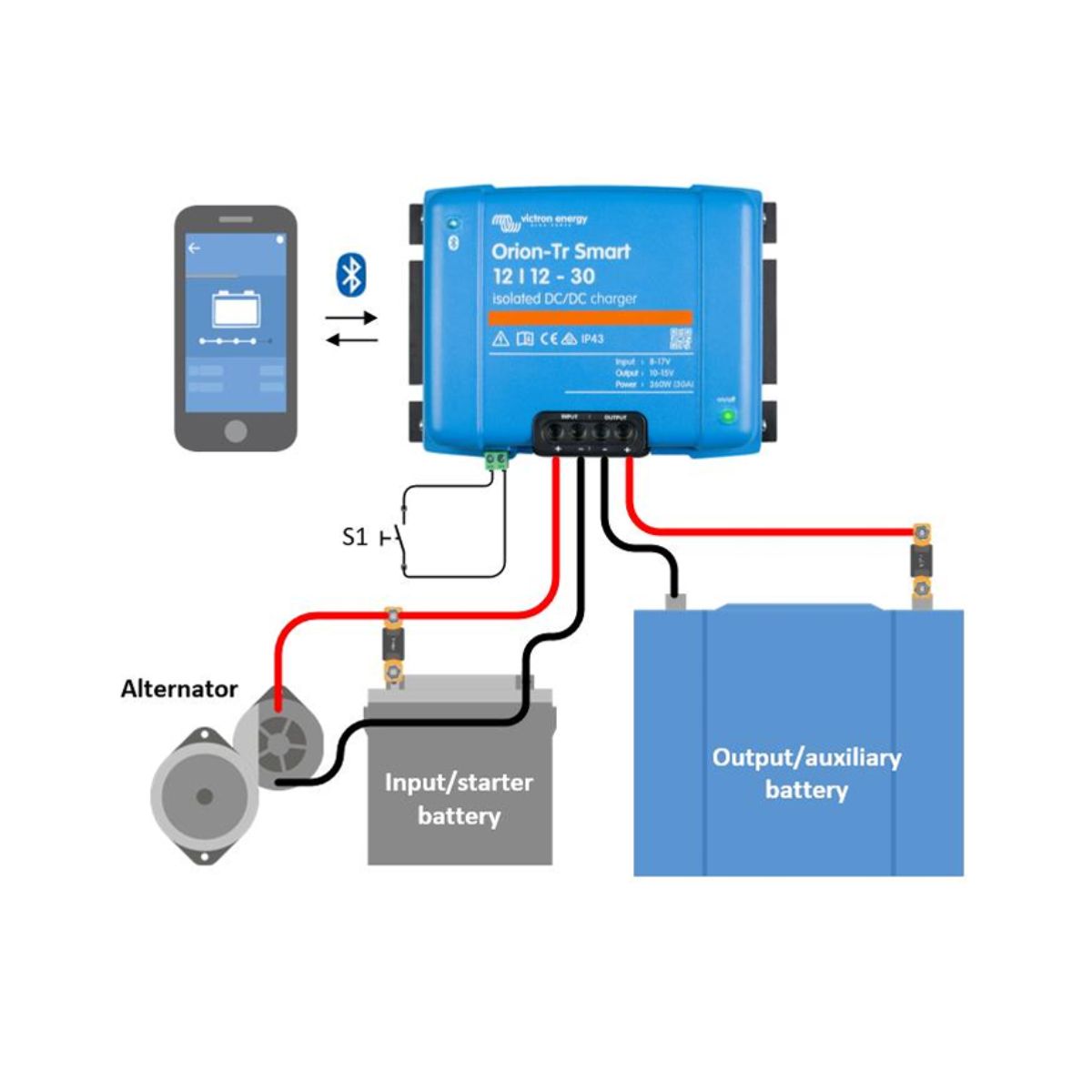
- description
The Orion-Tr Smart DC-DC charger is an adaptive 3-stage charger (bulk – absorption – float) designed for dual battery systems, such as in vehicles or on boats where the starter battery (hence the alternator) is used to charge the service battery. The name "Smart" comes from its built-in Bluetooth connection, where the charger can be monitored and configured via Bluetooth and can be remotely controlled via a remote on/off switch and has an engine running detection mechanism. This isolated model allows the input and output to have separate chassis grounds.
The Orion-Tr Smart charger can be used in 12V, 24V or 48V systems and is suitable for both lead acid and lithium batteries. Models are available up to 400W and unlimited multiple units can be connected in parallel to increase output power.
Suitable for high temperatures up to 55°C with a full rated output up to 40°C.
| Input Voltage Range | 32-70V |
| Under voltage shut down | 28V |
| Under voltage restart | 30V |
| Nominal output voltage | 12.2V |
| Output voltage adjust range | 12.2V |
| Output voltage tolerance | 10-15V |
| Output voltage tolerance | +/- 0.2V |
| Output noise | 2 mV rms |
| Cont. output current at nominal output voltage and 40°C | 30A |
| Maximum output current (10s) at nominal output voltage minus 20% | 40A |
| Short circuit output clinic | 60A |
| Cont output power at 25°C | 430W |
| Cont output power at 40°C | 360W |
| Efficiency | 87% |
| No load input current | <80mA |
| Standby current | Less than 1 mA |
| Can be used as power supply | Yes, output voltage can be set with Bluetooth |
| Galvanic isolation | 200 VDC between input, output and case |
| Operating temperature range | -20 to +55°C (derate 3% °C above 40°C) |
| Humidity | Max 95% non-condensing |
| DC connection | Screw terminals |
| Maximum cable cross-section | 16 mm2 (AWG6) |
| Protection category | IP43 (electronic components) IP22 (connection area) |
| Standards: Safety Emission / Immunity Automotive Directive |
EN 60950 EN 61000-6-3, EN 55014-1 / EN 61000-6-1, EN 55014-2 ECE R10-5 |